Balance exercises for seniors can help develop steadier movement, especially when they are part of a routine that also builds strength. Supported single-leg stands, weight shifts, and controlled stepping are practical ways to begin. Research supports balance and functional exercise programs for reducing falls in older adults, but the right starting point depends on your health and current ability.
If you have started feeling less confident on stairs, at curbs, or on uneven ground, you are not alone. These changes deserve attention—not the assumption that unsteadiness is simply something you must accept with age.
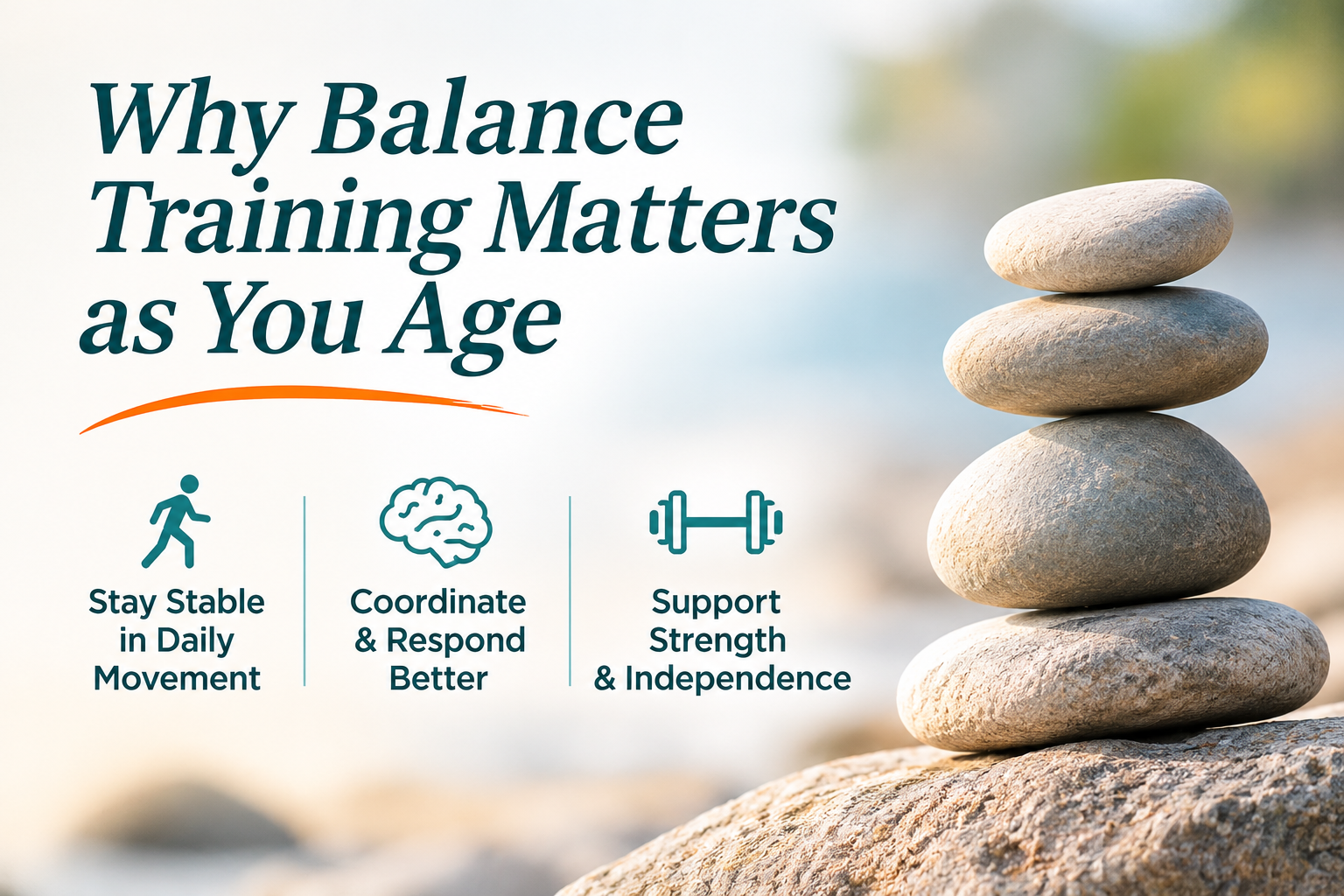
Why balance training matters as you age?
Balance is not only the ability to stand still. It is also the ability to stay stable while reaching, turning, walking, or moving from sitting to standing. Your brain uses information from your eyes, inner ears, and body-position sensors to coordinate these movements. Muscle strength and control help you respond when your position changes.
Everyday walking involves shifting your weight from one leg to the other. Targeted practice prepares you for that kind of task, rather than treating balance as a separate skill that only matters during an exercise class.
For adults over 50 who want to remain active, and older adults concerned about falls, balance training belongs alongside strength and general physical activity. The goal is to support the movements that let you keep participating in daily life.
Why does balance get worse with age?
Changes in muscle strength, vision, sensation, and reflexes can affect stability. Inner-ear disorders, foot problems, certain medications, and drops in blood pressure when standing can also contribute. Balance problems are not always caused by a lack of exercise.
This distinction matters. Repeated dizziness, a spinning sensation, new unsteadiness, or a fall should prompt a conversation with your healthcare professional. They can help identify the cause and decide whether you need physical therapy, vestibular rehabilitation, a medication review, or another form of care. Do not change prescribed medication on your own.
Sudden trouble walking or unexplained loss of balance can be a stroke warning sign, especially with facial drooping, one-sided weakness, or speech or vision changes. Call 911 rather than trying to exercise through those symptoms.
Can balance exercises help prevent falls?
Yes—appropriately designed exercise programs can reduce falls among older adults living in the community. A 2019 Cochrane review found that programs emphasizing balance and functional exercise reduced the rate of falls by approximately 24% compared with a control group. 1
That figure describes fewer falls over time across study groups. It does not mean that every person’s chance of falling drops by exactly 24%, or that the four exercises below reproduce the full programs tested in research.
Fall prevention also includes checking vision, reviewing medications with a professional, wearing suitable footwear, and reducing home hazards. Exercise is an important part of the plan, not the entire plan. 5
Before trying balance exercises at home
Use a level, well-lit area with enough space to move. Wear supportive, nonslip footwear and keep pets, loose rugs, and other obstacles away. Position yourself beside a fixed countertop or another secure support that will not move. A rolling chair or unstable piece of furniture is not suitable. 2 5
Begin only if you can stand securely with support. If you have fallen, need a walking aid, experience dizziness, or cannot stand steadily, seek individualized guidance before attempting standing balance drills. Stop if an exercise causes pain, dizziness, or a feeling that you may fall. 6
Give the exercise your full attention. Avoid practicing while brushing your teeth, handling hot drinks, or doing another task. The aim is a manageable challenge—not a situation in which you are likely to lose your balance.
4 beginner balance exercises for seniors
These are general examples, not a personalized treatment plan. Keep support available throughout and use a smaller movement or shorter hold if needed. The supported standing and stepping examples are adapted from NHS exercise guidance.
1. Supported weight shifts
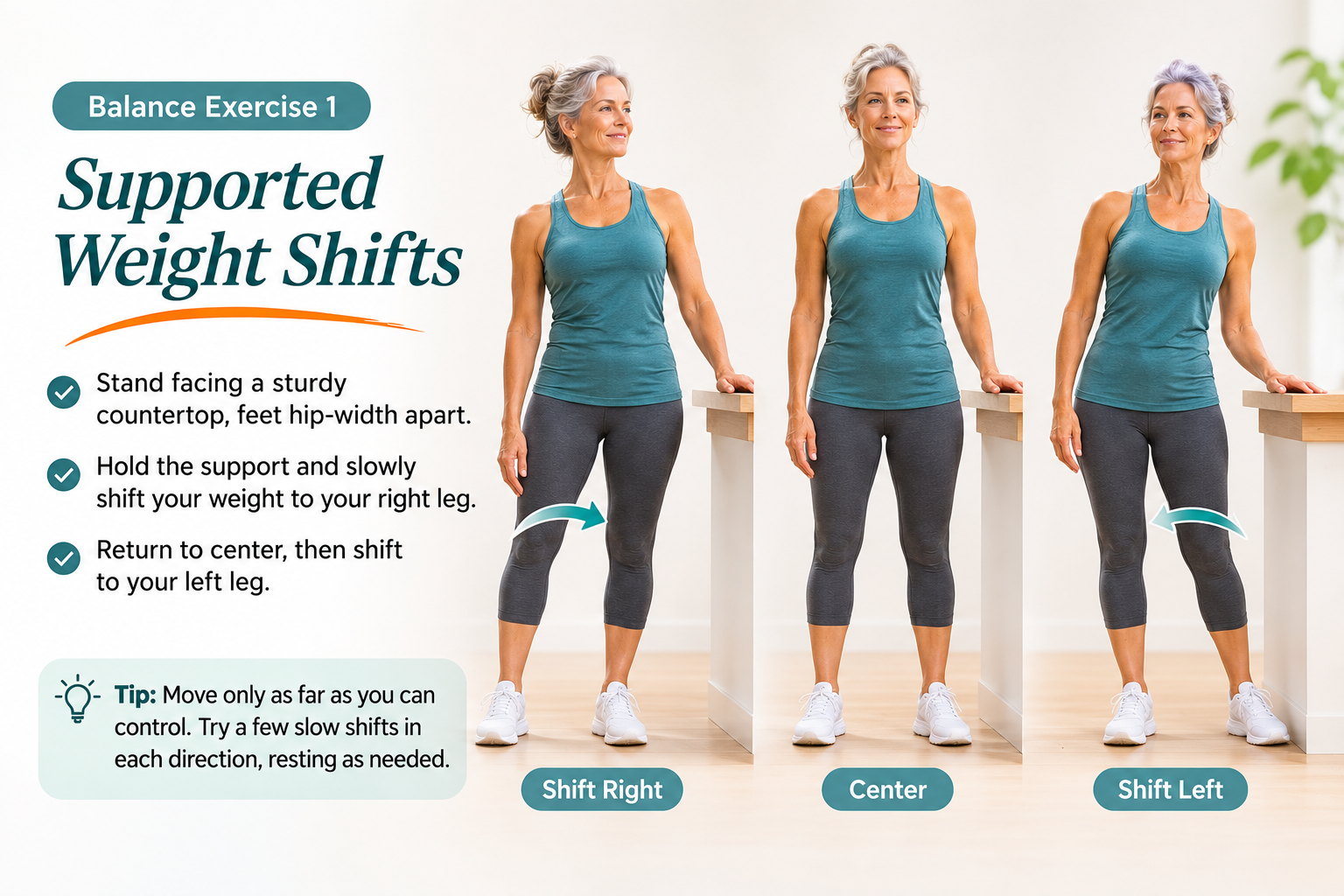
Stand facing a sturdy countertop with your feet about hip-width apart. Hold the support and slowly shift some of your weight toward your right leg, keeping both feet on the floor. Return to the center, then shift toward your left leg.
Move only as far as you can control without leaning sharply or feeling unsteady. Try a few slow shifts in each direction, resting when needed. This is an easier starting option than immediately lifting a foot off the floor.
2. Supported single-leg stands
Stand beside or facing your secure support and hold it. Keep your standing knee slightly relaxed and lift the other foot a small distance from the floor. Keep your hips level rather than leaning sideways.
If comfortable, hold for 5–10 seconds, place the foot down, and switch sides. NHS guidance suggests up to three holds on each side. Shorter holds are fine when you are beginning; maintaining control matters more than reaching a number.
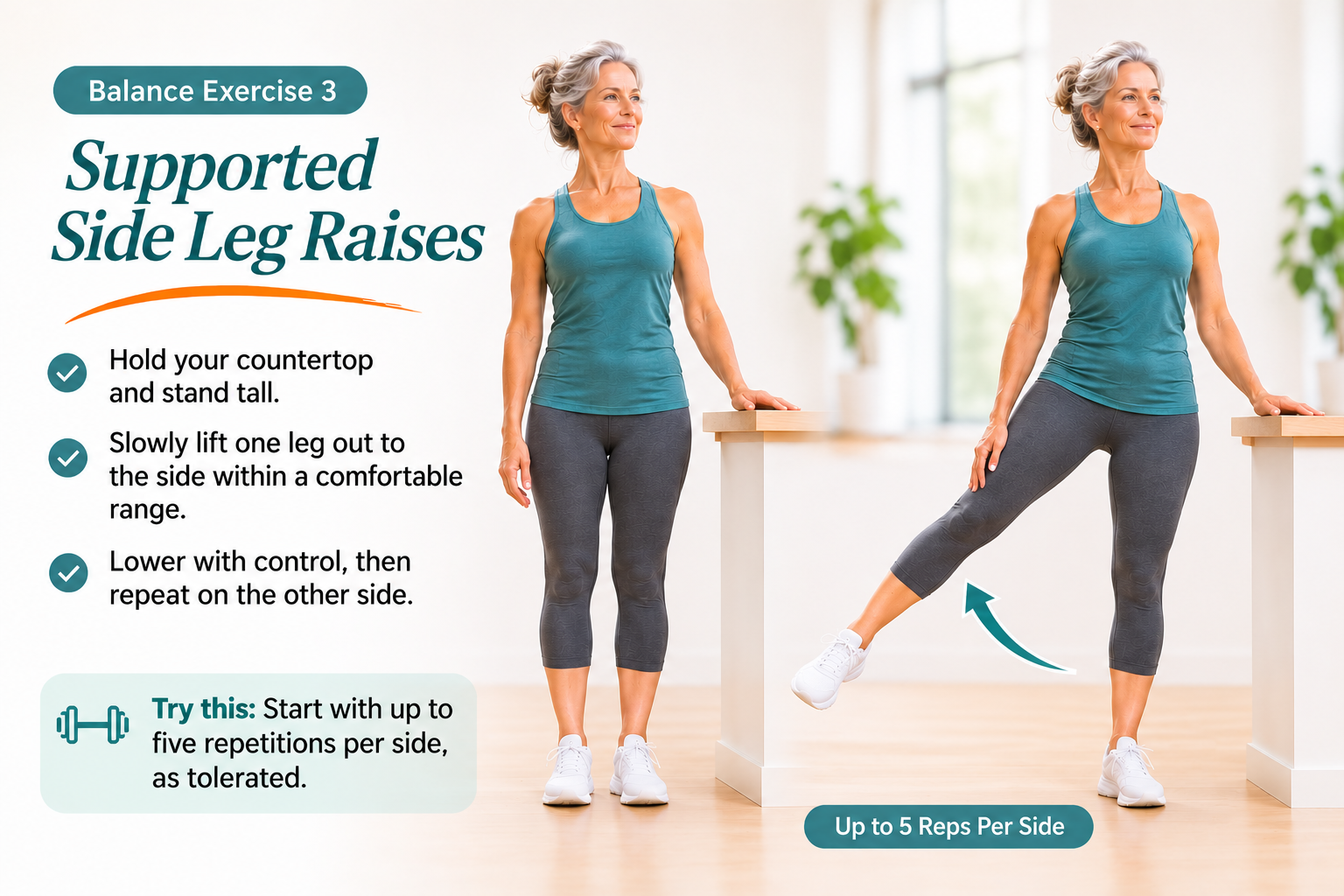
3. Supported side leg raises
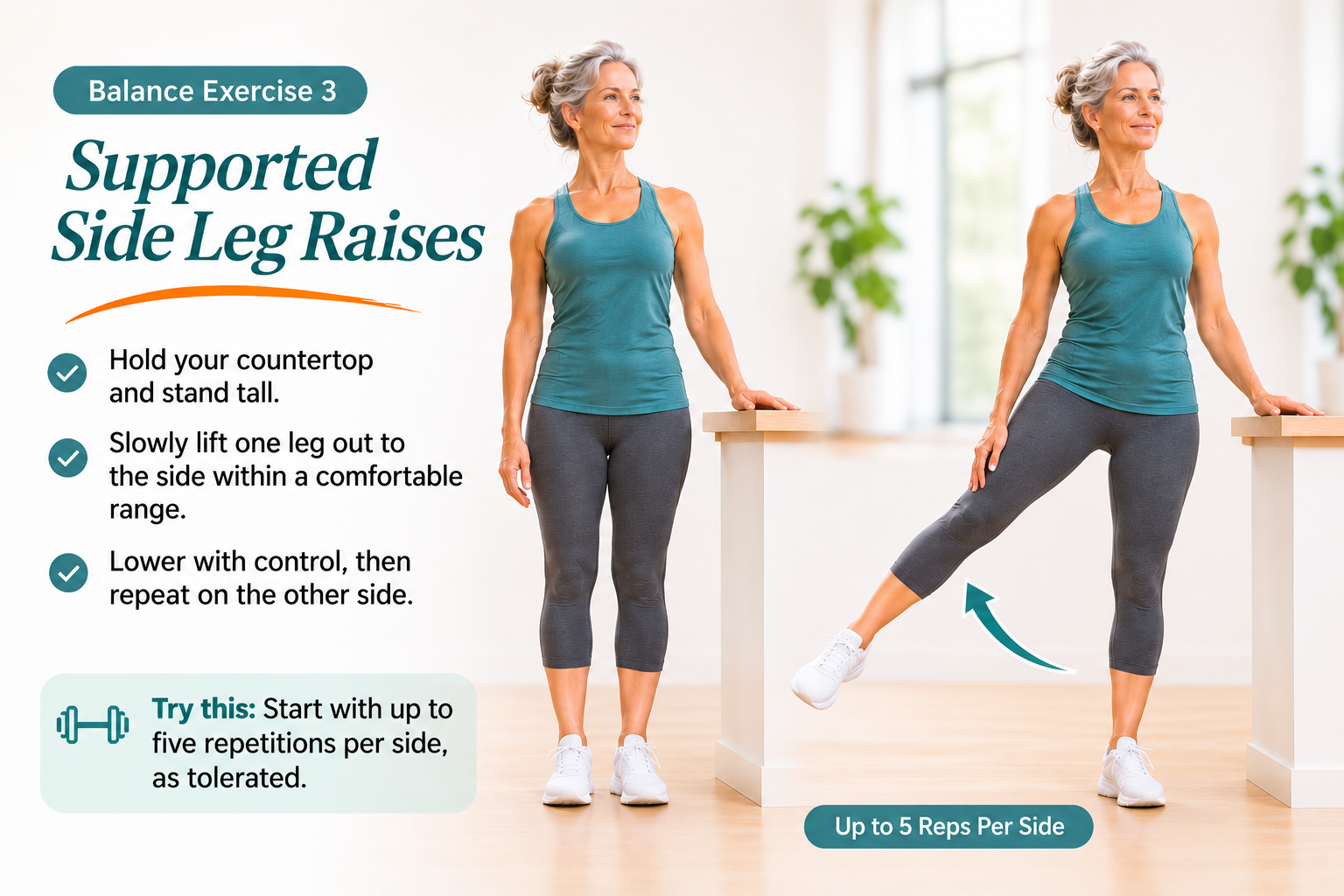
Hold your countertop and stand tall. Slowly lift one leg out to the side within a comfortable range, keeping your back and hips upright. Lower the leg with control, then repeat on the other side.
Start with up to five repetitions per side, as tolerated. Do not swing the leg or lean your torso to make the movement larger. This adds a hip-strengthening exercise to your balance routine.
4. Supported heel-to-toe walking
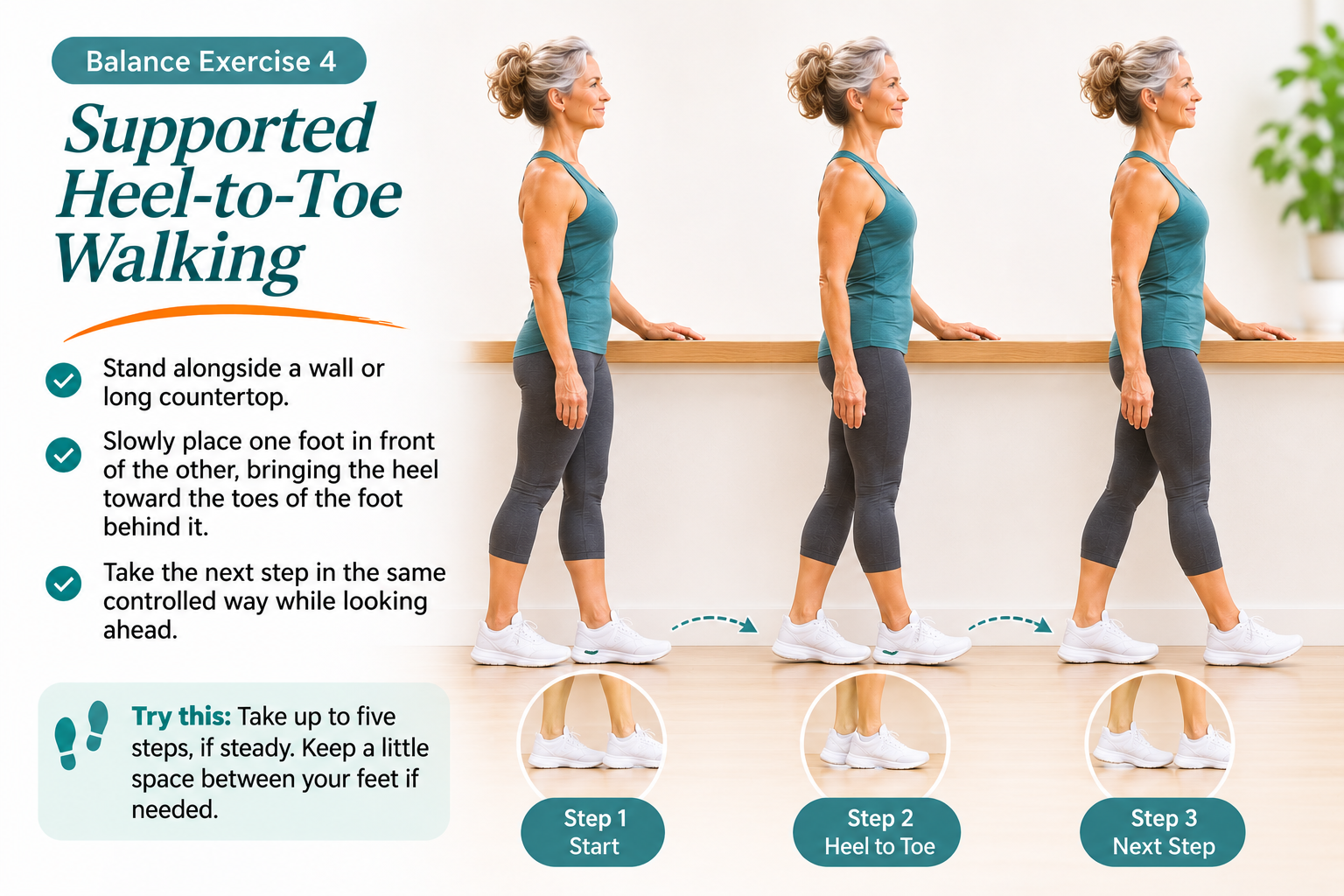
Stand alongside a wall or long countertop so support remains within easy reach. Slowly place one foot in front of the other, bringing the heel toward the toes of the foot behind it. Take the next step in the same controlled way while looking ahead.
Try up to five steps if you can do so steadily. If placing your feet directly in line feels too difficult, keep a little space between them or return to supported weight shifts. Do not attempt this drill without assistance if you cannot safely release a foot to step.
How often should older adults practice balance?
The World Health Organization recommends that adults 65 and older include varied activity emphasizing functional balance and strength at moderate or greater intensity on three or more days per week. Older adults should start with small amounts and adjust their effort to their ability. 4
For someone beginning with supported exercises, a brief practice session can help establish the habit. However, five minutes of easy standing drills should not be presented as a complete, proven fall-prevention program. The amount and difficulty need to develop appropriately over time.
Balance work complements walking and other aerobic activity, but walking alone does not provide every element of balance-focused training. The Cochrane review did not establish that walking-only programs reduce falls. 1
If you are returning after time away from exercise, begin gradually rather than restarting at your previous level. Our related article on why stopping and starting a workout routine can lead to injury discusses the value of consistent, sustainable movement habits.
How to progress without increasing your fall risk
Progress might mean completing a few more controlled repetitions or holding a position slightly longer—not immediately removing support. Change one element at a time and keep the exercise within your ability. NHS guidance recommends building up gradually.
Do not rush into eyes-closed balance drills, unstable surfaces, or head-turning challenges. These can increase the difficulty substantially and may be inappropriate when dizziness or a balance disorder is involved. A qualified professional can help select suitable progressions.
For individualized exercise guidance, explore specialized movement training at Selina’s Therapy Center. Sessions begin with a movement assessment and are tailored to the client’s goals and ability. Medical evaluation or rehabilitation may be more appropriate when an underlying disorder or significant fall risk is present.
Can balance training reduce fear of falling?
Fear of falling can lead people to avoid walking, shopping, or social activities. That is understandable, particularly after a fall, but withdrawing from movement is not the only option. A suitable plan can help you practice with support and build confidence gradually.
A Cochrane review found that exercise may produce a small to moderate reduction in fear of falling immediately after a program. The evidence was limited, and longer-term effects were uncertain. Balance training should not be promised to eliminate fear for everyone.
If worry is preventing you from leaving home or participating in everyday activities, discuss it with your healthcare professional. Physical confidence and the emotional impact of a fall may both need attention.
Frequently asked questions about improving balance
Is standing on one leg the best balance exercise?
It is one useful option, not a complete routine or a universal best choice. An effective program may combine standing balance, stepping, strength, and other functional tasks. People who cannot safely stand on one leg should start with a more supported option or professional guidance.
Can I improve my balance after 60 or 70?
Older adults can benefit from appropriately designed exercise programs. Your age does not determine the exact exercise you should do; your current strength, health, mobility, and support needs matter. Persistent imbalance still needs evaluation rather than being dismissed as aging.
Do I need special equipment?
The beginner examples above do not require gym equipment. They do require a safe space and secure support. A professional may recommend additional equipment or a different type of training based on your needs.
Personalized movement training in Pacific Grove
At Selina’s Therapy Center, we focus on personalized movement training and therapeutic bodywork for people who want to remain active. For balance-related exercise goals, movement training is the relevant service; it does not replace a medical falls assessment or treatment for an inner-ear disorder.
If you are in Pacific Grove or the Monterey Peninsula, contact Selina’s Therapy Center about movement-training sessions. We can discuss your goals and whether the service fits your needs.
The purpose of balance training is not to prove that you never need support. It is to practice at an appropriate level so everyday movement can become more manageable. Start gradually, keep support available, and seek guidance when you need it.
This article provides general education, not individualized medical advice or a rehabilitation prescription. The exercises are not suitable for everyone. Consult a healthcare professional about dizziness, falls, new balance problems, or conditions that affect safe exercise.