Why Stopping and Starting Your Workout Routine Can Lead to Injury
You may still remember what you could lift three weeks ago. Your body may not be ready to do it today.
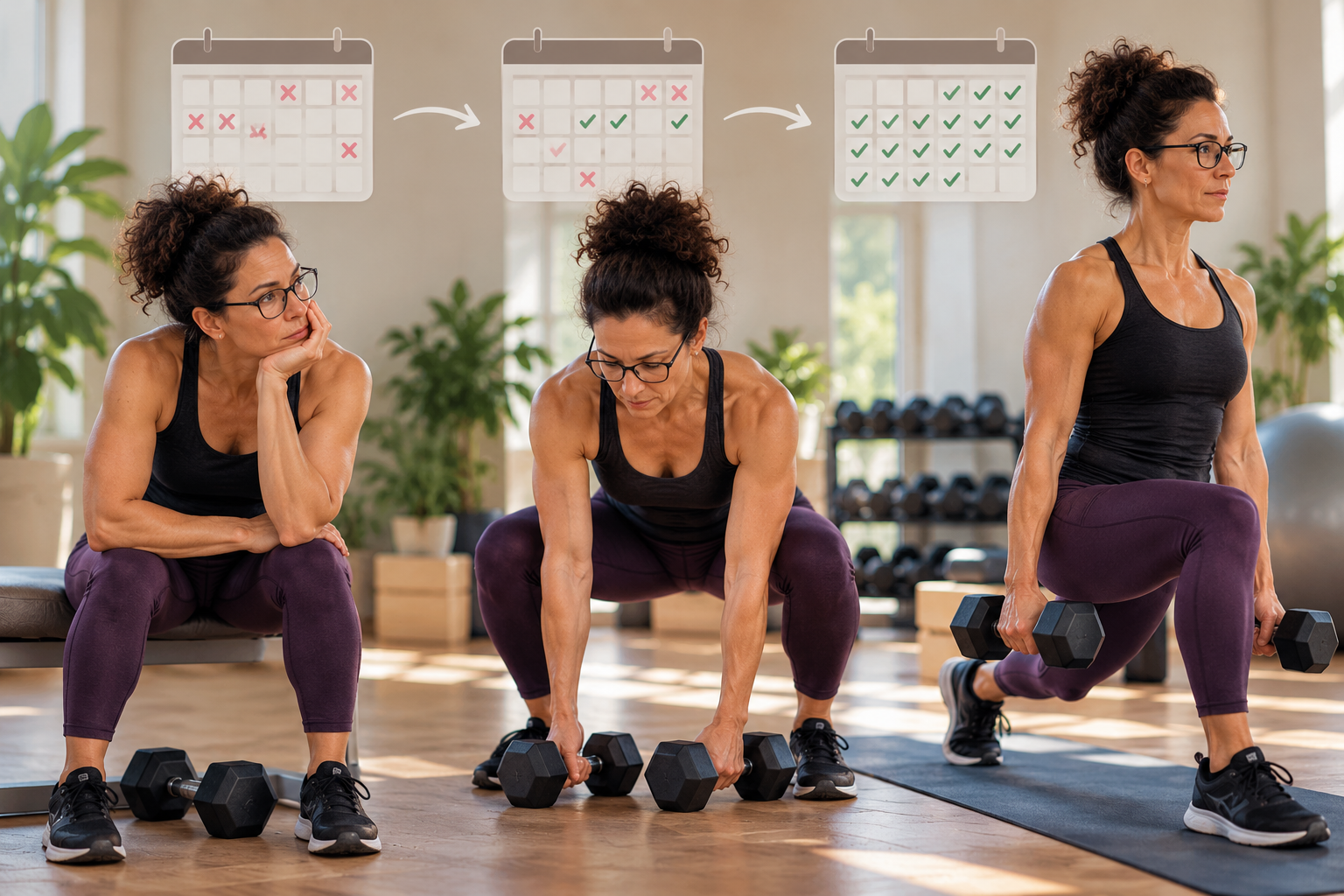
One of the patterns I see with adults in their 50s, 60s and 70s is an inconsistent approach to strength training. They exercise for a week or two, miss several weeks, then return expecting to pick up exactly where they left off.
That can be a problem.

Strength Is Only Part of the Picture
When people think about losing fitness during a break, they usually think about losing strength.
But strength is not the only thing that matters.
Good strength training also depends on coordination, balance, joint control, muscular endurance and your body's ability to stabilize a joint while it is under load.
Those qualities are built through regular practice.
After time away from training, you may still feel strong enough to move the same weight. That does not necessarily mean your body is prepared to control that weight as well as it did before the break.
This is one reason the stop-and-start cycle can get people into trouble.
Your Brain Remembers the Weight
There is another problem.
Your memory of what you can do often lasts longer than your conditioning.
If you were doing shoulder presses with a certain weight a few weeks ago, that weight still feels familiar when you return. So you grab the same dumbbells.
But your recent training volume has changed.
Your muscles have had less exposure to load. Your movement may be less coordinated. The smaller muscles responsible for controlling and stabilizing the joint may fatigue sooner.
The weight hasn't changed. Your preparation for it has.
This Matters More as We Get Older
I work primarily with adults over 40, and consistency becomes increasingly important as we age.
That doesn't mean people in their 60s and 70s should avoid challenging exercise. Quite the opposite. Maintaining strength is incredibly important as we get older.
But challenging the body and surprising an unprepared body are two different things.
You don't need to train hard every day. You don't even need a perfect exercise schedule.
You do need enough consistency that your body has a chance to adapt to what you're asking it to do.
Two appropriately programmed strength sessions every week, performed consistently, can be far more useful than training hard for several days and then doing nothing for three weeks.
What If You Have to Take Time Off?
Life happens.
You travel. You get sick. Work becomes overwhelming. Family needs your attention. Sometimes your body simply needs a break.
Missing workouts isn't the problem.
The mistake is returning as though you never stopped.
If you've been away from strength training for a few weeks, give yourself a short rebuilding period. Reduce the weight, volume or intensity. Pay attention to your control and range of motion. Give your body a chance to become accustomed to loading again.
You can build back up.
There is no prize for doing it in one workout.
Consistency Doesn't Mean Perfection
This is where many people get stuck.
They believe an exercise routine only counts if they can follow the entire program. If they can't make three workouts that week, they do none.
I would rather see someone consistently strength train once or twice a week than repeatedly train four times a week, disappear for a month, and start all over again.
Your body responds to what you do repeatedly.
Find a routine you can realistically maintain.
Where Massage and Bodywork Fit In
Massage can also be a valuable part of an active lifestyle, particularly when training volume increases or certain areas repeatedly become tight, sore or restricted.
Bodywork can help address muscular tension, improve comfort and make it easier to notice areas that aren't moving or feeling the way they normally do.
But massage isn't a substitute for progressive strength training, and it can't protect you from doing too much too quickly.
I see the two as complementary.
Strength training helps build a body that can tolerate load. Bodywork can help support recovery, mobility and awareness along the way.
The Goal Is to Keep Moving
Exercise becomes more important as we age, not less.
The goal isn't to be afraid of lifting heavier weights or challenging yourself. The goal is to build enough consistency that your body is prepared for those challenges.
If you haven't exercised in several weeks, don't punish yourself for missing time and don't try to make up for it.
Simply start again at the level your body is ready for today.
Then keep showing up.
Selina's Therapy Center
Helping Adults 40+ Stay Strong, Active, and Pain-Free
Pacific Grove and the Monterey Peninsula
References
Baxter, B. A., Baross, A. W., Ryan, D. J., & Kay, A. D. (2024). Effects of detraining on neuromuscular function and structural adaptations following once- or twice-weekly eccentric resistance training in older adults. Aging Clinical and Experimental Research, 36. The study found that some muscular adaptations regressed after training stopped, although many neuromuscular improvements were maintained during the 12-week detraining period. PubMed
View study on PubMed
Chaabene, H., et al. (2022). Use It or Lose It? A Meta-Analysis on the Effects of Resistance Training Cessation (Detraining) on Muscle Size in Older Adults. International Journal of Environmental Research and Public Health, 19(21), 14048. The review found that resistance training increases muscle size in older adults and that longer periods of training cessation are associated with loss of some of those adaptations. PubMed Central (PMC)
Read the study
Siddique, U., et al. (2022). Determining the cortical, spinal and muscular adaptations to strength-training in older adults: A systematic review and meta-analysis. Ageing Research Reviews, 82, 101746. The review found strong evidence that strength training improves maximal force production, rate of force development and muscle activation in older adults. PubMed
View study on PubMed
Davis, H. L., Alabed, S., & Chico, T. J. A. (2020). Effect of sports massage on performance and recovery: A systematic review and meta-analysis. BMJ Open Sport & Exercise Medicine, 6, e000614. Across 29 studies involving 1,012 participants, massage did not improve strength or endurance performance, but was associated with small improvements in flexibility and delayed-onset muscle soreness. BMJ Open Seminars
Read the BMJ study