The scale tells you whether your weight changed. It cannot tell you what changed.
Was it body fat? Muscle? Water? That is where a body fat analysis can add useful information. It estimates your body composition so you can look beyond pounds alone—especially when you compare readings taken under similar conditions. It does not give a perfectly precise explanation of every weight fluctuation.
At Selina’s Therapy Center, I use the InBody 270 to help clients understand those estimates and put them in context. My goal is not to give you another number to worry about. It is to help you ask better questions about your progress.

What is body fat analysis, and why look beyond the scale?
Body fat analysis is part of body composition analysis: an assessment of how much of your weight comes from fat and fat-free tissue. Two people can weigh the same and have different amounts of body fat and muscle.
The distinction matters when you are trying to change your weight or remain strong as you age. Losing pounds is not necessarily the same as losing only fat. Maintaining muscle and strength matters for everyday movement, and resistance training can help older adults preserve muscle and mobility.
That is why I look at body composition alongside how you move, how your training is progressing, and what you want to be able to do. The scan is one source of information—not a replacement for those observations.
What happens during an InBody 270 scan?
You stand barefoot on the device’s foot electrodes and hold its handles. The InBody 270 uses bioelectrical impedance analysis, or BIA. A low-level electrical current passes through the body, and the device uses the measured electrical resistance to calculate body-composition estimates. You do not normally feel the current.
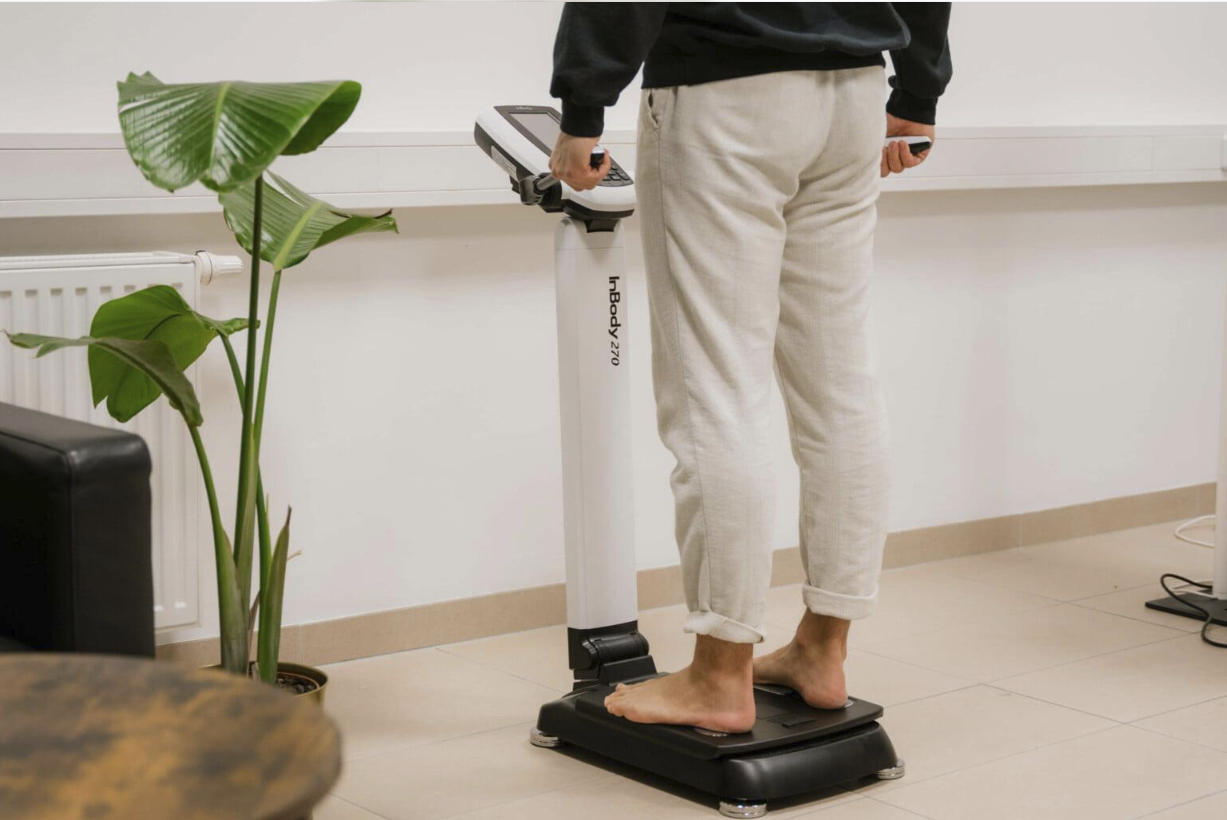
The instrument measurement takes about 15 seconds, but that is not the length of the full appointment. Our Body Fat Analysis service in Pacific Grove takes approximately 15 minutes, including a short consultation, the scan, and a walkthrough of your printout.
We review what the numbers mean, which comparisons are useful, and what might have affected the reading that day.
What does your body composition report show?
Body fat mass and body fat percentage
Body fat mass is the estimated amount of fat in your body. Body fat percentage expresses that amount as a proportion of your total weight. Looking at both helps you avoid treating a percentage alone as the whole story.
Skeletal muscle mass
This is an estimate of the muscle attached to your skeleton—the muscle involved in moving your body. It is useful to follow over time, but it is not a direct test of strength, movement quality, or injury recovery.
Total body water
The report also estimates total body water. Hydration matters because water influences electrical conductivity and therefore the calculations. Muscle contains water, so muscle and water are not two separate categories you can simply add together to explain your weight.
Segmental lean analysis
This section estimates fat-free tissue in each arm, each leg, and your trunk. It can highlight differences worth discussing, but it does not directly measure the strength of each limb or prove that one side has a muscular problem. Lean tissue includes water and other nonfat components—not muscle alone.
Estimated basal metabolic rate
Basal metabolic rate, or BMR, estimates the energy needed for essential functions at rest. It is not your total daily calorie requirement or a personalized eating prescription. Activity and other factors affect your daily needs.
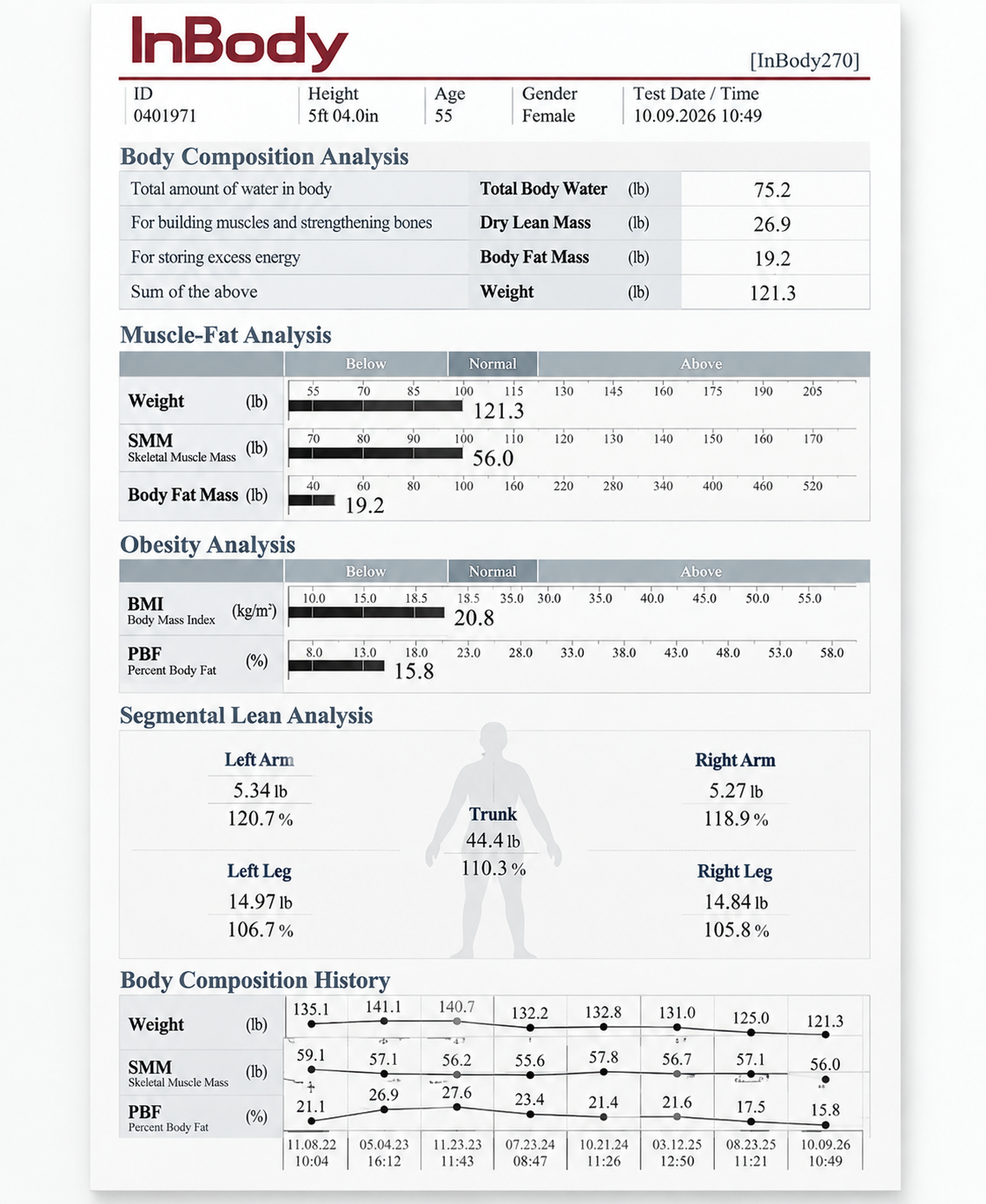
Your InBody 270 report provides valuable insights into your body composition, but understanding what those numbers mean is just as important. During your consultation, Selina will walk you through each measurement, explain how it relates to your health and fitness goals, and help you identify areas for improvement. The Body Composition History section becomes especially useful with repeat visits, allowing you to track changes in body fat, muscle mass, and weight over time.
How accurate is an InBody body fat analysis?
I would rather explain the limits up front than let you assume the printout is an exact description of your body.
BIA estimates can change with hydration, recent food or fluid intake, exercise, and testing conditions. A controlled study using a different InBody model found that fluid intake affected some body-composition estimates over a short period. Those changes did not mean participants suddenly gained new fat or muscle tissue.
It is also important to distinguish repeatability from accuracy. A device can give consistent readings and still differ from another assessment method. Research comparing several InBody models with DXA, a commonly used research reference method, found high repeatability alongside systematic differences in estimated fat and fat-free mass.
For that reason, I do not treat a single result—or a tiny change between visits—as a verdict. Comparable repeat readings are more useful for discussing a trend, but even a trend needs context. Changing machines or comparing an InBody number directly with a DXA number can make interpretation harder.
How should you prepare for a body fat analysis?
The aim is to make each visit as comparable as possible, not to manipulate the result.
Use a similar time of day. Repeat testing under a consistent routine when possible.
Keep normal fluid intake. Current general InBody guidance recommends normal hydration the day before and hydrating about an hour before testing. Avoid deliberately dehydrating yourself or drinking a large amount immediately before the scan.
Allow time after eating. Current general InBody guidance recommends waiting at least three hours after your last meal.
Avoid testing immediately after exercise. Allow proper recovery and ask us about the recommended interval when booking.
Use the restroom beforehand. Arrive ready to stand upright for several minutes before measurement, and wear similar, light clothing for repeat visits.
Ask us to confirm the current preparation instructions before your appointment. If meal or fluid timing conflicts with medical advice you have received, follow your clinician’s advice and tell us. If something was different on the day, we will take that into account rather than overinterpreting the result.
How often should you check your body composition?
For clients tracking a training goal, I often suggest a follow-up after four to six weeks. That is a practical interval I use, not a universal medical rule or a guarantee that every change will be large enough to interpret.
Testing daily is rarely helpful for this purpose. Short-term fluctuations can distract from the question that matters: are the longer-term estimates moving in a way that fits your goals, your training, and how you feel?
I look for patterns, not perfection. If a reading is unexpected, we review the conditions before assuming you gained fat or lost muscle.
How does the analysis fit with training and massage?
Numbers are useful when they help us have a more informed conversation. If a segmental result shows a difference between sides, I compare it with a movement assessment rather than assuming the scan alone tells us which exercise to prescribe.
Our Specialized Movement Training provides personalized exercise guidance based on assessment and your goals. Some clients choose a Half & Half session, which combines targeted exercise with therapeutic massage in the same appointment.
The scan tracks estimates; the movement assessment helps guide exercise. Massage is a separate bodywork service—not a treatment for a body-fat number. If you are recovering from an injury, following medical restrictions, or concerned about unexplained weight or muscle loss, those concerns belong with your healthcare professional.
Who should not have an InBody 270 scan?
Do not use the InBody 270 if you have a pacemaker or another implanted electronic medical device. Tell us before booking. The manufacturer warns that the electrical current can interfere with medical devices.
InBody also does not recommend testing during pregnancy. That is manufacturer guidance, not a claim that harm has been established. Let us know if you are pregnant, have another medical implant, or cannot safely stand and hold the handles so we can discuss whether this service is appropriate.
At our center, this is a wellness and tracking service. It does not diagnose a condition, establish an ideal body-fat target, or replace medical advice.
Book a body fat analysis in Pacific Grove
If you want to understand what may be changing beyond the scale, book your Body Fat Analysis and consultation at Selina’s Therapy Center, 620 Lighthouse Avenue, Suite 165, Pacific Grove.
We will review your InBody 270 printout together and discuss how to use it sensibly. You will leave with a clearer understanding of the report—not a promise that one scan can tell you everything about your health.
This article provides general education. Body-composition results are estimates and should be interpreted with your health history, testing conditions, and goals. Speak with a qualified healthcare professional about unexplained weight changes, muscle weakness, or medical and nutrition concerns.