Massage Ball for Myofascial Release: How to Choose One and Use It Correctly
A massage ball is the simplest recovery tool I know of. It costs less than a single massage session, fits in a gym bag, and it is far more precise than a foam roller. I recommend one to clients who want something they can use between massage appointments or training days, especially when one specific spot keeps bothering them.
But more pressure is not better.
Almost every week I watch someone find a painful spot, wedge a rock-hard ball underneath it, and push as hard as they can. The assumption is that if it hurts, it must be working. That is not how I teach it, and it is not how I use it. The goal is to apply controlled pressure, give the area time to respond, and come away feeling better, not bruised.
The Massage Ball I Recommend
You do not need complicated equipment for self-myofascial release.
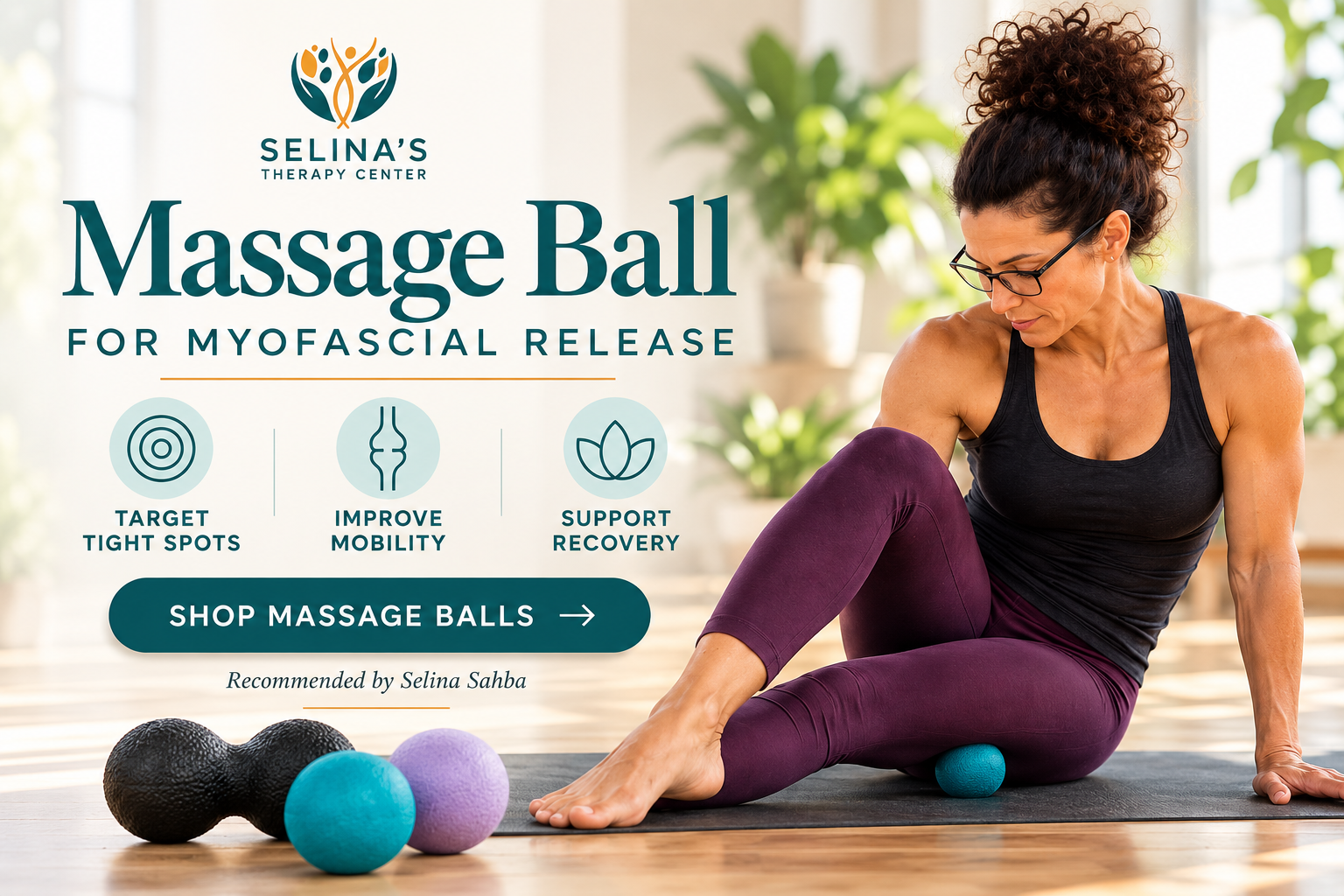
For most people I prefer a purpose-made ball about 5 to 6 inches across. It gives more targeted pressure than a foam roller while letting you control exactly where that pressure lands. The same ball works for the glutes, chest, upper back, hips, and the soles of your feet, and it is small enough to keep at home or throw in a bag.
One detail matters more than most people realize: grip. A ball that shoots across the room every few seconds is a ball you will stop using.
One detail matters more than most people realize: grip. A ball that shoots across the room every few seconds is a ball you will stop using.
What Is Self-Myofascial Release?
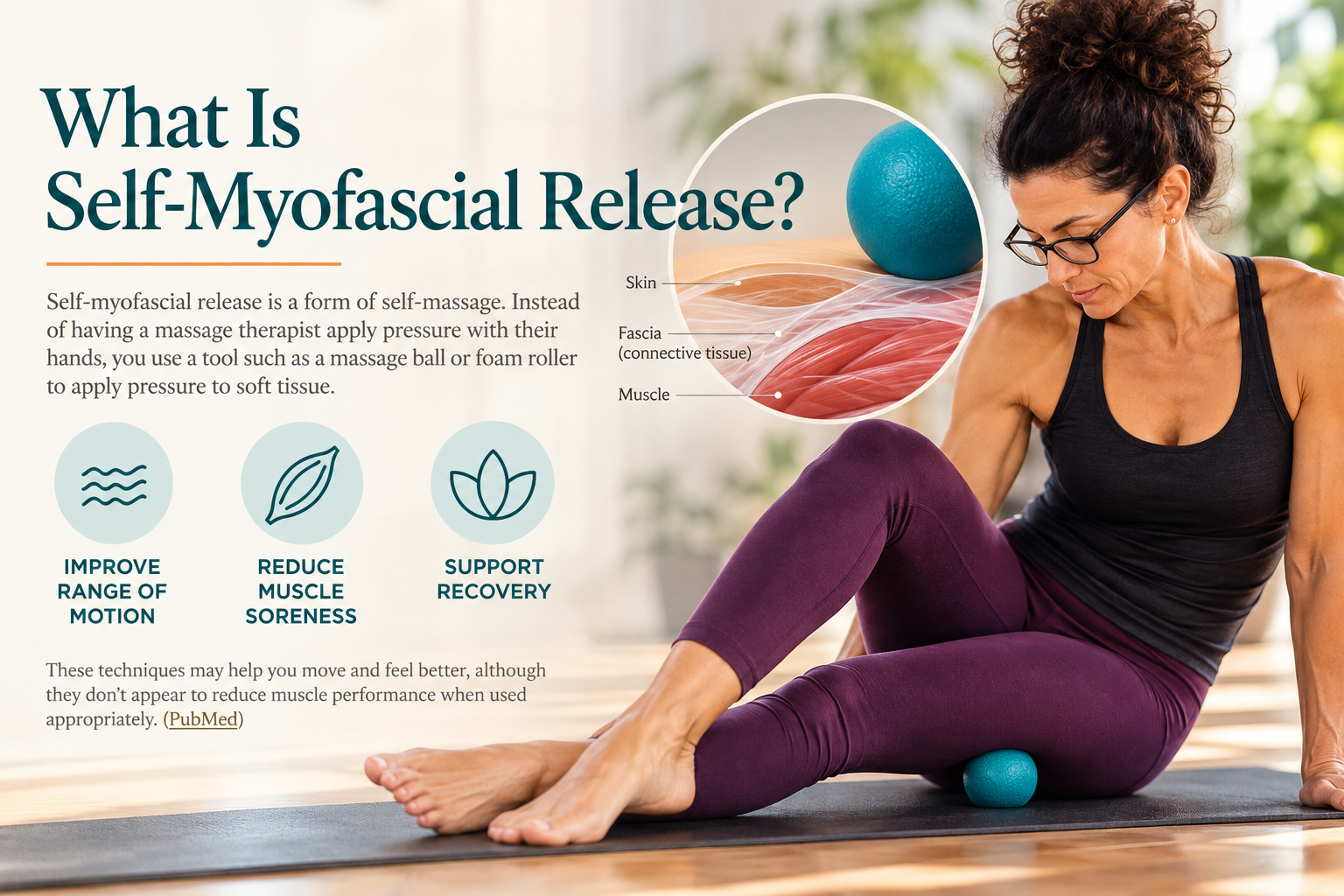
Self-myofascial release is self-massage with a tool. Instead of a therapist's hands applying pressure, you use a massage ball, a roller, or something similar on your own soft tissue.
Research on these tools is fairly consistent:
They can improve joint range of motion in the short term without reducing muscle strength or performance (Cheatham et al., 2015).
Compared with doing nothing, foam rolling produced a clear improvement in range of motion but it was not better than ordinary stretching (Wilke et al., 2020).
The most consistent benefit found was less post-exercise soreness, with about 90 seconds per muscle group as the minimum helpful dose (Hughes & Ramer, 2019).
Despite the name, we do not have good evidence that rolling physically "releases" or breaks apart fascia. Fascia is not a tight band waiting to be snapped. What you feel afterward is probably more complicated than a change in the tissue under the ball. Your nervous system, your sensitivity to pressure, your muscle tone, and your breathing all play a part. The practical result is what most people notice: an area that felt tight and guarded feels easier to move.
Why a Massage Ball Instead of a Foam Roller?
A foam roller is excellent for covering large areas — quads, hamstrings, lats, the whole upper back. If you already own one, my Foam Rolling 101 guide covers which muscles to prioritize and how to use it.
A massage ball does the opposite. It concentrates pressure into a smaller area, which makes it useful for spots a roller cannot reach or cannot isolate.
Comparing self-massage tools
| Tool | Best for | Pressure | Control |
|---|---|---|---|
| Foam roller | Large muscle groups, general warm-ups | Broad, spread over a wide surface | Easy |
| Massage ball (5–6 in)My pick | Glutes, hips, chest, upper back, feet | Focused but adjustable | Very good |
| Lacrosse ball | Deep, very focal work on thick muscle | Very high, even with light body weight | Easier to overdo |
| Spiky ball | Feet, forearms, hands | Surface stimulation more than depth | Good |
| Tennis ball | Beginners, sensitive areas, travel | Gentle, with some give | Good |
The smaller the surface, the more pressure it transfers. That is what makes a ball useful — and why you have to use it carefully.
Which Massage Ball Should You Use?
You do not need the hardest ball you can find.
A tennis ball is a good starting point because it has some give. If you are new to self-massage or sensitive to pressure, this may be all you need.
A purpose-made massage ball holds its shape and is more durable. For most people who exercise regularly, this is the one I prefer.
A lacrosse ball is considerably harder. It has its place, but I would not start there.
A spiky or textured ball adds surface sensation. People often like these for the soles of the feet.
Firmness is not the only variable, and harder is not automatically better. One small study compared a soft inflatable ball with a hard massage ball placed under the neck: the softer ball compressed the deep tissue more, while producing far less muscle guarding and discomfort (Kim et al., 2019).
That matches what I see in practice. The ball you can relax into usually does more than the ball you have to brace against.
Don't Start on the Floor
This is the biggest change I make when I teach someone to use a massage ball. Start against a wall.
Place the ball between your body and the wall, then lean in gradually until you feel pressure in the muscle you are trying to address. The wall gives you much better control, because you can back off in an instant.
On the floor, a much larger percentage of your body weight can travel through a very small area of tissue. It escalates fast. Once you know what appropriate pressure feels like, floor work can be useful for some areas, but it is not the place to learn.
How to Use a Massage Ball and How Much Pressure to Use?
Choose your surface. Wall first. Floor later, if you want more pressure.
Place the ball on muscle, not on bone. Move it off the bony edges before you lean in.
Lean in gradually. Add pressure until it is noticeable but manageable.
Move slowly until you find a spot that feels tight, tender, or different from the tissue around it.
Stop there. Instead of rolling aggressively over it, hold gentle, sustained pressure for about 20 to 30 seconds. Breathe normally and notice whether the sensation begins to change.
Make small movements. Tiny circles or gentle shifts back and forth are usually enough.
Come off the ball. Move on, or stop for the day.
I want the pressure to feel tolerable enough that you can breathe normally and keep the rest of your body relaxed. If you are clenching your jaw, holding your breath, or bracing your whole body against the ball, you are using more pressure than you need. Back off.
How Long and How Often Should You Use a Massage Ball?
Shorter than most people expect. About 20 to 30 seconds on a specific tender spot, and roughly 90 seconds to two minutes per muscle group. A total session of three to five minutes is plenty. You do not need to spend twenty minutes on one muscle.
Daily use is generally fine, and many of my clients keep a ball by the couch and use it while watching television. If an area is bruised or sore to the touch the next day, you used too much pressure, not too little.
Research has not settled on one perfect pressure, speed, or duration for self-myofascial release — studies use different techniques and protocols, which is why there is no universal prescription (Cheatham et al., 2015).
One more thing: if the same muscle needs a ball every single day, that is information. Something is likely keeping it tight, and I cover that below.
Where a Massage Ball Works Best
A ball is useful for the areas a roller cannot isolate:
Glutes and outer hips
Upper back
The muscles around the shoulder blades
Chest and the front of the shoulder
Calves
Hamstrings
The soles of the feet
Where Not to Use a Massage Ball
Directly over bones, joints, or the spine
The front or sides of the neck
An acute injury, significant bruising, or swelling
Any area with unexplained numbness or tingling
Anywhere that produces sharp, electrical, burning, or shooting sensations
That last one is not a signal to push harder. It is a signal to stop. A massage ball is a self-care tool. It is not a way to diagnose or treat an injury. If something repeatedly hurts or does not improve, it is worth finding out why.
Before or After Exercise?
Both can work, with different intentions.
Before exercise, keep it brief, a couple of minutes, not a full session. You want the area to feel comfortable moving. A 2025 study comparing tools found that all self-massage conditions slightly reduced squat velocity, and the massage ball was the least detrimental of them (Aragão-Santos et al., 2025).
After exercise, you can spend a little more time on muscles that feel worked or sore. This is where the evidence is most supportive: myofascial rolling appears to reduce post-exercise soreness in the short term (Hughes & Ramer, 2019).
When a Massage Ball Isn't Enough
If the same muscle is constantly tight, rolling it every day may make it feel better without addressing why it keeps becoming irritated.
That is when I start looking at the bigger picture:
• Is another muscle not doing its job?
• Is your training volume too high?
• Are you missing strength or stability somewhere?
• Is your movement pattern repeatedly loading the same tissue?
• Is the discomfort actually coming from somewhere else?
Sometimes the muscle that hurts is not the source of the problem. If your tightness is stubborn and widespread, hypermobility is one reason it keeps coming back, and it needs a different approach than rolling harder.
This is where professional bodywork and deep tissue work and a movement assessment can do far more than chasing sore spots with a ball. Massage, strength training, movement, and self-myofascial work do not need to compete, which is exactly why I combine massage with specialized movement training.
Frequently Asked Questions
• What is the best massage ball for myofascial release?
For most people, a purpose-made ball around 5 to 6 inches across: firm enough to reach muscle, forgiving enough to relax into. A tennis ball is a fine starting point, and a lacrosse ball is much harder and easier to overdo.
• Can a massage ball actually release fascia?
We do not have good evidence that any rolling tool physically breaks down fascia. What the research supports is short-term improvement in range of motion and less post-exercise soreness. The change you feel likely involves your nervous system and your tolerance to pressure as well.
• Should a massage ball hurt?
You will feel pressure, and tender spots can be uncomfortable — but not sharp and not unbearable. If you are holding your breath or bracing, you are using too much.
• Is a massage ball better than a foam roller?
Not better — different. A roller covers large areas well. A ball is more precise and better for the glutes, hips, chest, upper back, and feet. Many people benefit from having both. If you are comparing tools in general, I have also written about massage guns for muscle recovery and when they help.
• Can a massage ball help with plantar fasciitis or foot pain?
Rolling the sole of the foot is comfortable for many people, and the foot is one area where a ball works far better than a roller. Persistent foot pain deserves an assessment rather than endless rolling.
• Where should you not use a massage ball?
Avoid bones and joints, the front and sides of the neck, acute injuries, bruised or swollen tissue, and any area with numbness, tingling, or sharp, electrical, or shooting sensations.
A Simple Tool Worth Keeping Around
You do not need a drawer full of recovery gadgets. A massage ball is inexpensive, portable, and easy to use. It gives you targeted pressure in areas that are hard to reach with a foam roller, and you decide exactly how much pressure goes in.
More importantly, it teaches you to pay attention. You begin to notice differences from one side of your body to the other, what normal muscular soreness feels like, and which areas tighten up after certain activities.
Use the ball gently. Move slowly. Don't chase pain. And if an area keeps bothering you despite your efforts, that is usually a good reason to stop treating the symptom and figure out what is causing it.
This article is educational and is not medical advice. If you have an injury, a medical condition, or symptoms that concern you, please speak with a qualified health professional.
About the author
Selina Sahba, CMT, NASM-CPT, ACE-CPT, is a massage therapist and movement trainer in Pacific Grove, California, with more than 24 years of experience. She is certified by all three massage schools on the Monterey Peninsula and combines clinical bodywork with NASM-certified and CHEK-informed movement training. Meet Selina
Working on a stubborn area that keeps tightening back up? Book a session at Selina's Therapy Center in Pacific Grove — serving Monterey, Carmel, and the Monterey Peninsula.
References
Kim, Y., Hong, Y., & Park, H. S. (2019). A soft massage tool is advantageous for compressing deep soft tissue with low muscle tension: Therapeutic evidence for self-myofascial release. Complementary Therapies in Medicine, 43, 312–318. PubMed
Cheatham, S. W., Kolber, M. J., Cain, M., & Lee, M. (2015). The effects of self-myofascial release using a foam roll or roller massager on joint range of motion, muscle recovery, and performance: A systematic review. International Journal of Sports Physical Therapy, 10(6), 827–838. PubMed
Wilke, J., Müller, A. L., Giesche, F., Power, G., Ahmedi, H., & Behm, D. G. (2020). Acute effects of foam rolling on range of motion in healthy adults: A systematic review with multilevel meta-analysis. Sports Medicine, 50(2), 387–402. PubMed
Hughes, G. A., & Ramer, L. M. (2019). Duration of myofascial rolling for optimal recovery, range of motion, and performance: A systematic review of the literature. International Journal of Sports Physical Therapy, 14(6), 845–859. PubMed
Aragão-Santos, J. C., Da Silva-Grigoletto, M. E., & Behm, D. G. (2025). Effects of foam roller and massage ball with and without vibration on squat load-velocity profile of resistance trained adults. Journal of Sports Science and Medicine, 24(3), 485–494. PubMed